
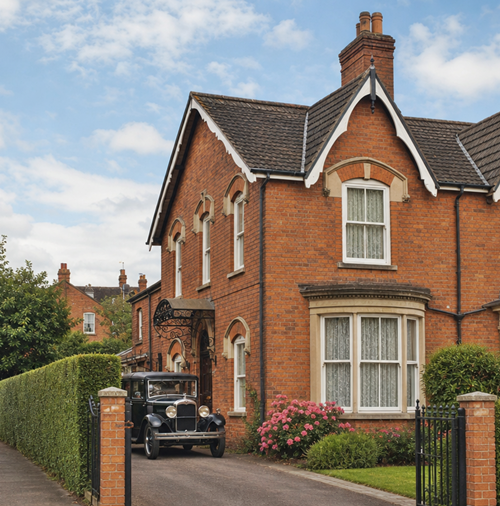
Tipperary House, Grantham. Lincolnshire

There’s a well-known Irish story, as old as the hills of Ireland themselves – it goes, that a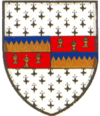 man was travelling through the beautiful countryside of Ireland, when he came to a crossroads with signposts pointing in all directions but none of the names on the signposts meant a thing to him.
As luck would have it, a local man was strolling by at that moment, so the traveller approached and asked him:
“Sir, can you tell me the best way to Tipperary from here, please ?”
The local man thought about the question, thinking deeply and finally answered him with hesitation:
“Sure, if I was going to Tipperary, I wouldn’t start from here.”
It would be easy to laugh at this and dismiss it as a rather silly answer and an Irish idiosyncrasy of expression, but there’s more to it than meets the casual eye !
Isn’t it the truth, that, given the choice, in so many aspects of our lives, we “wouldn’t start from here” either ?
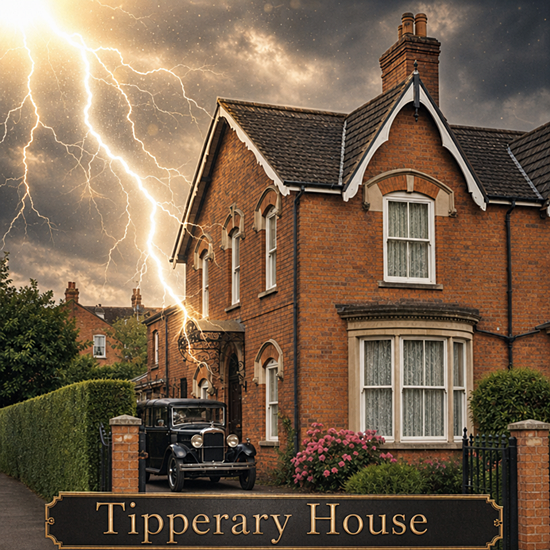
Tipperary House – The Power of Place in Grantham
As an international therapist, healer and life-coach et al, I know that in life, whether it’s applying for a new job, buying a house, maintaining our health, taking up writing or saying something to someone which needs to be said – the truth is, we so often don`t start from an ideal place.
All of us have baggage from the past. Old fears, traumatic memories and the rest. We also have current life challenges whether they are to do with relationships, money, health, family and work responsibilities or a multitude of other things including constraints of time.
All of these conspire to challenge us on the journey to our particular destination, our own Tipperary or Nirvana or Destiny if you like – whatever that may be.
My Tipperary has brought me to Grantham in Lincolnshire and beside the River Witham. This area for me personally is a timeless place with a magnetic quality.
I spent my earliest years up to the age of fourteen growing up in the City of Nottingham which is only 21 miles away as the crow flies from Grantham.
Then in 2011 after my second visit to this magical area of Lincolnshire, I felt completely at home among strangers where I felt a tangible sense of calm and togetherness as I soaked up the vital atmosphere of the place.
I decided then to move from London where I had been located for years and come and live here and work from Grantham and make it my home.
When I came to Grantham in 2011 and bought this beautiful Victorian house on Dudley Road in November 2011, I decided to call it “Tipperary House” – my Tipperary !
But why you may ask would I actually call a house in Lincolnshire, “Tipperary” just on that thought alone ??
Well, here is my full story of the many, many reasons to call it “Tipperary House” and the serendipity of it all:
The name Tipperary is derived from the Irish “Tibrad Ara”, or “Tiobraid Arann” which means “House of the Well or Spring of Ara”.
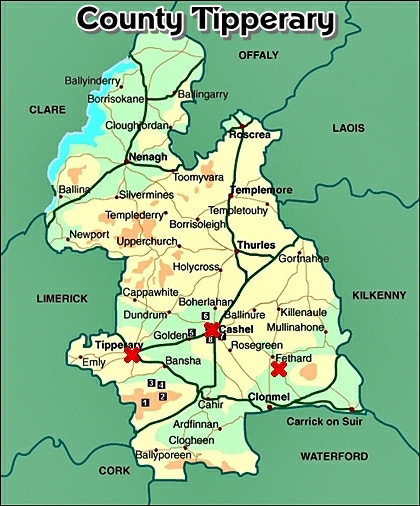
Ara is the name of the attractive River Ara, which passes through what is now Tipperary Town. A market town set in the heart of the ‘Golden Vale‘, a paradise of rich soil and green pastures in Ireland.
The town originally grew up around this well or spring from the River Ara and later a castle was erected by Prince John (later King John of England) in the 12th Century when he was Lord of Ireland as the Norman invader. Today – the motte, of this motte-and-bailey castle can be seen at the north of the town at the same side of the River Ara as the sacred well. King John`s mother was Eleanor of Aquitaine married to King Henry II of England whom I am related to through the Plantagenets.
Incidently, King John is the monarch of Medieval England most associated with the signing of the Magna Carta in 1215.
So, I have a very old and historical connection to the beginning of what is now Tipperary and the development of the area after that. Indeed, I ended up with both a very proud indigenous Irish Celtic and Anglo-Norman heritage with a direct and long-standing connection to the County of Tipperary through the centuries with my father‘s family being a noble family from County Tipperary, having settled there for generations as merchants, gentry, and landed estate holders from the mid-17th to the 19th centuries.
In the mid-19th century, branches of the family were proprietors of estates across the county, notably holding thousands of acres in places like Millbrook (near Cappawhite), Drangan, Kyle, and the historic St Johnstown Castle Estate. Their lands and properties—primarily leased estates rather than vast ancestral domains—gradually transitioned to tenants through the sweeping Irish Land Acts passed from the late 19th through the early 20th centuries. Some more information from 1837
Going right back in time – I am a direct descendant of Jane De Vere Hunt (1793–1871).
She is my 3rd great-grandmother who married Thomas Millett on September 18th, 1812, and is a descendant of the noble and historic Oxford De Vere family dating back to 1066.
Her family line claimed direct descent from the House of de Vere, an ancient and illustrious Norman-English noble family that held the title of Earl of Oxford for over five centuries.
By marrying Jane, Thomas Millett brought this heavy historical prestige into his own family line.
The Milletts were so proud of this noble English connection that it completely transformed their naming traditions.
For the next century, the family continuously passed down the names Damer Hunt Millett, Captain Hunt Millett, and De Vere Millett through the generations.
The De Veres were also hereditary holders of the office of Lord Great Chamberlain of England from 1133 until the death of the 18th Earl in 1625. Their primary seat was Hedingham Castle in Essex, but they held lands in southern England and the Midlands, particularly in eastern England.
I was fascinated to learn that Alfred, Lord Tennyson (who was born in Somersby, Lincolnshire) and was Poet Laureate of the United Kingdom during much of Queen Victoria’s reign was a close friend of my 3rd great-grandmother`s extended family, the De Vere Hunt’s of Curraghchase in County Limerick. He maintained a lifelong correspondence with the family. Both my great-grandmother and Alfred lived at the same time.
He was particularly good friends with a member of her family, the Anglo-Irish poet and critic Aubrey de Vere.
Alfred spent several weeks as a guest at the de Vere family’s Curraghchase estate, notably visiting for five weeks in 1848.
The estate’s landscape is widely believed to have inspired Alfred’s famous 1832 poem “Lady Clara Vere de Vere“.
During his stays, the family’s artistic environment was said to inspire Tennyson’s creative visions, including tales of the mystic “Lady of the Lake” rising from the estate’s waters.
The Millett‘s were a prominent family (Irish Norman) for generations in the county of Tipperary and a part of the Protestant Ascendancy of Ireland.
Later, my grandfather (Thomas) married a catholic woman (Hanorah) in January, 1915 from the mountain of Slievenamon, beside Killusty Village near Fethard in County Tipperary or (Irish: Sliabh na mBan) which means “mountain of women`.
According to my father, this appeared to estrange my originally Protestant grandfather from his earlier family, and they all chose to withdraw from one another. My father said he never really got to know his father’s side of the family which he would have loved to.
His father (my Grandad) was never comfortable talking about it.
It’s hard to understand why a family would want to cut another member out of their life, but these were changing, strange, and disruptive times in Ireland through the Irish Land Act 1903 and subsequent legislation like the Irish Land Act 1923 and the Irish Civil War which was a conflict that followed the Irish War of Independence from 1919 – 1921 and accompanied the establishment of the Irish Free State which was deeply shaped by the Catholic Church in Ireland. The political influence of the traditional Protestant establishment in the new Irish Free State faded rapidly. It was the end of an era that would never return.
The end of the Protestant Ascendancy was largely viewed as a positive and necessary step for democratisation and social justice, as it dismantled centuries of institutional inequality and land monopoly against the Catholic majority.
However, its collapse sadly brought immense hardship, violence, and cultural loss to the minority Anglo-Irish community.
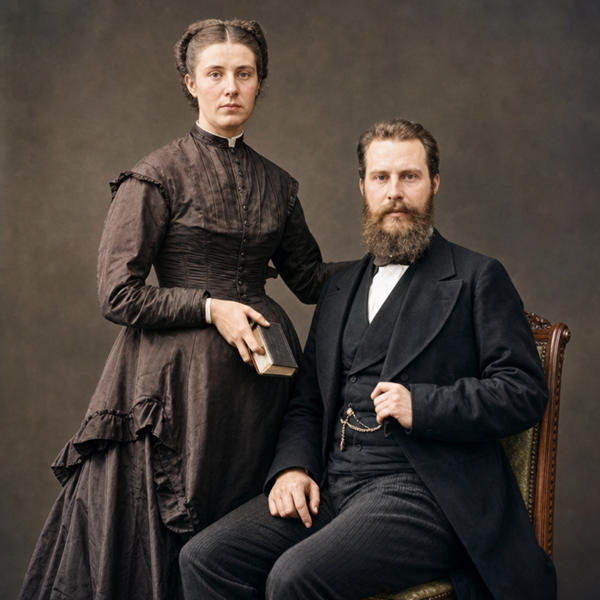
My great grandparents Thomas Millett “Gentleman” and his wife
(my great grandmother) Maria [pron. Mariah) (Hayden) Millett taken 20 Feb 1871
in County Tipperary on their wedding day at the Church of Ireland in Killenaule.

While formal legal disinheritance for mixed marriages in Ireland was largely abolished by the repeal of the Penal Laws in 1833, it remained socially and culturally common for Protestants in Ireland to be disinherited or cut off by their families for marrying Catholics at that time.
The opposite was true too with Catholics. While ostracisation was more common from landed or wealthy families, Catholic families frequently cut off, ostracised, or severely clashed with relatives who married outside their Catholic faith due to strict ecclesiastical rules and intense social pressure. My grandfather converted to or raised his own children (my father) in the Roman Catholic faith after marrying Hanorah. However, this was never made clear if he officially and actively converted. He always appeared as religiously unaffiliated.
Opposite seated are my father’s parents Thomas and Hanorah Millett on their wedding day in January, 1915.

The mountain of Slievenamon, (Irish: Sliabh na mBan) which means
“mountain of women`.
My grandmother Hanorah was born on the mountain of Slievenamon on August 1, 1892 as was my own father (Matt) after that – he was one of 10 children.
Hanorah was very wise, and a healer in her own right. She would have appeared to have inherited her father’s small estate on the mountain.
She was a small woman in stature but a giant in spirit – a matriarchal figure that guided, rejuvenated and empowered others, Nora was well-known and liked by all.
The mountain is said to have got its name from the ancient fairy women or Feimhin, who enchanted a warrior named Fionn Mac Cumhaill and his followers.
It is said that Fionn decided to choose his bride from the first of these women racing to reach the summit to meet him sitting at the top of Slievenamon. My grandparents Thomas and Hanorah were very much devoted to each other throughout their lives !!
I spent a number of years myself living in County Tipperary which my family relocated back to after leaving Nottingham some years ago when I was a young teenager.
And it`s interesting too that when investigating its history, County Tipperary was established in 1211 exactly 800 years ago this year when I bought this Victorian house here in Grantham and when I was considering calling it “Tipperary House”. My father is buried in County Tipperary and my mother currently lives there in the principal town (Clonmel) and will in time end her days there too.
It is interesting that the number 8 as in (800 years) is a power of two, being two cubed, and is the first number of the form p3, being an integer greater than 1.
It is also the highest feminine number, and first and foremost it is about balance. The 8 is the great Karmic equaliser, with an increase in energy and focus – it also shows confidence, it is infinitely looping, but looks you right in the eye !
Anyway, Tipperary Town today is this Irish modern day town and also Tipperary is the name of the county in which Tipperary Town dwells.
Sadly, the original ancient sacred well which really gave Tipperary its name is now closed up in Tipperary Town but it was located near the north bank of the River Ara in Bridge St., just off the Main Street and at which King Brian Boru is reputed to have washed his wounds after a battle. Brian Boru was an Irish king who ended the domination of the High Kingship of Ireland by the Uí Néill and is said to have ended Viking invasion and their domination of Ireland.
In olden “Celtic” times, it was important to travellers to have access to wells as they moved between the two most important areas of this region, Cashel of the Kings and the monastery at Emly.
This well was famous throughout history and continued to be highly treasured and prized for centuries by locals for the purity of its waters until about sixty years ago when it was forgotten.
Initially when I wanted to choose a location for a house in Grantham and unconsciously chose this one and bought it – it dawned on me later that this house, the front room bay-window, the front garden and driveway in Dudley Road face out to the street and due West.
I was then reminded of the ancient Celtic and Druidic symbolism and tradition where the cardinal directions, the three realms and the sacred elements were important.
West = (The Beautiful Sea / Water – Muir – phonetically “Mweer”) means emotion, our intuitive being, psyche, spirit oriented, our ancestors, business, energy, it’s our blood and movement.
The front door of the house faces due North = (The Present Earth – Talam – the midworld – phonetically “TAH-luhv”) which to the Celts symbolised home, stability, security and fertility, it’s our body – therefore, a perfect combination and balance for my home and my work which surprised and of course delighted me.
This house was perfect and ticked all the boxes after the event of buying it ! It was meant to be !
Another reason and an emotive one perhaps with leaving London, and in calling my new house “Tipperary House” is in reference to the World War I-era song written by Englishmen music hall performers Harry Williams and Jack Judge (Jack’s grandparents came from Tipperary as mine did also).
“It`s A Long Way to Tipperary” written in 1912 became popular among the British military as a marching song and the words in the song:
It’s a long way to Tipperary,
It’s a long way to go,
It’s a long way to Tipperary,
To the sweetest girl I know.
Goodbye Piccadilly! Farewell Leicester Square.
It’s a long, long way to Tipperary,
But my heart’s right there.
I have left London after being there for 25 years to come and live in this new house in Grantham and metaphorically said “Goodbye Piccadilly! Farewell Leicester Square” to come here.
As the song goes ‘it’s a long way to go’. Actually it’s not a long way anymore ! In our modern world which is getting smaller, we are seeing farther.
“Tipperary House” situated in Grantham is located approximately 26 miles south of the city of Lincoln, and approximately 24 miles east of Nottingham.
Grantham stands on the East Coast Main Line railway (London-Edinburgh) and is only just over an hour by train from London`s King Cross.
Originally located on the historic A1 (Great North Road), the main north-south road which was an early northern route used by the Anglo-Saxons (the Old English name for the route was ‘Earninga Straete’) and the Romans (Ermine Street) as the route from London to Lincoln and York. It was later used by mail coaches between London and Edinburgh and is therefore very accessible and not `a long way to go`! !
It would have been the route also of the famous, daring and dashing highwayman, Dick Turpin who famously rode from London to York on his faithful mare, Black Bess.
I think, all in all, it‘s worth the little extra mileage and you are most welcome to come and find out for yourselves by visiting me, Grantham and Lincolnshire. Why Not ?
But perhaps the main reason now and most confirming one together with the others for naming the house “Tipperary House” was our latest finding which was a huge surprise and this happened shortly after buying the house while cleaning up the garden.
We found an actual well in the garden that was hidden and lost and forgotten in all the undergrowth just like “The Well of Ara “ in Tipperary Town !!
The lady we had bought the house from had been living here a number of years and didn’t even know it was there !
What a lovely surprise and I believe – pure serendipity !
Has the “Well or Spring of Ara” been reborn again in my new home in Grantham ?
Or is it the “Well or Spring of Witham” that has been discovered and been waiting for me ? (The River Witham is across the street).
Only time will tell, I guess !
A friend of mine asked ‘forgetting the metaphysical, isn`t Tipperary a strange name for a house in Lincolnshire all the same – purely on a cultural and historical level` ?

I disagreed completely because originally we were all Celto-Britons and inter-related tribes in these islands. Both regions share Celtic and later Norman and Anglo-Norman heritage. Grantham, Lincolnshire and Tipperary are the same – the same roots, history, ideals and culture with the same traditions.
It is interesting that both County Tipperary and Lincolnshire were historically divided into specific administrative districts known as “ridings” making them unique in comparison to counties with standard unitary or single-council governance.
Riding is derived from the Old Norse word for a “third part”, this geographical division is famously seen in Yorkshire, but both Lincolnshire and Tipperary adopted similar unique administrative structures.
County Tipperary:
In 1838, the county was divided into two separate administrative jurisdictions known as the North Riding and South Riding, each with its own county town (Nenagh and Clonmel).
Lincolnshire:
The county was traditionally structured into three major historical sub-divisions or parts: Lindsey, Kesteven, and Holland.
Lindsey itself was historically composed of three ridings: North, South, and West.
County Tipperary is spiritually renowned as a landscape layered with ancient myth, early Christian monastic heritage, and profound natural sanctuaries. Often described by pilgrims as a “thin place” where the boundary between the physical and spiritual worlds feels close, in other words “Thin places” are locations where the boundary between the material and spiritual worlds feels so fragile that heaven and earth seem to meet.
County Tipperary is indeed a treasure trove of profound and beautifully preserved sacred sites. It blends legendary royal seats with ancient abbeys and serene holy wells, capturing over 1,500 years of Irish history.
Likewise, Lincolnshire boasts a profound medieval heritage and spiritual character deeply rooted in its monumental Christian heritage, rich medieval history, wealthy monasteries, and royal rebellions, and expansive, tranquil landscapes.
Its historic capital, Lincoln, was a powerhouse of medieval England, boasting unparalleled architectural triumphs and hosting defining moments in British political and religious history.
Apart from its important early Celtic influence like Tipperary, Lincolnshire is steeped in Norman history with its castles and cathedrals and Tipperary is the same with its castles and monastic heritage. The energies are the same in both places !
The River Witham is directly across the road from my house on Dudley Road and running right in front (North – South) and cutting directly across the entire property into which my well is connected just like the River Ara and “House of the Well of Ara” in Tipperary Town.
Importantly, it was here in the River Witham that the Celtic Witham Shield was found in 1826 directly linking the two places again from very early times on a heritage, historical and cultural basis.
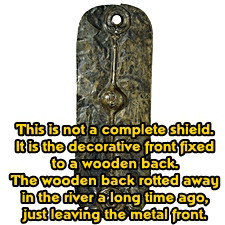
The shield was found in the vicinity of Washingborough and Fiskerton outside the city of Lincoln up river from the house in 1826.
It is the finest example of early La Tène Celtic Art from Britain.
The Witham Shield has been dated to 400-300 BC and is now in the British Museum in London.
Indeed, in this area around Fiskerton up river from the house on Dudley Road, hundreds of artifacts of Celtic and later Anglo-Saxon origin were found including a wooden causeway.
At this place, at this time, the river was tidal and the evidence suggests a trading and metal working centre with trading connections to northern Europe and other parts of Britain and Ireland too.
So, therefore there is a very strong old Celtic connection to this area as well as Norman and Anglo-Norman and subsequently a continual historical and cultural link to Tipperary, its Norman heritage and of course, Tipperary`s Celtic Cashel of the Kings – a county and landscape that was the ancient and actual main seat of the high Celtic Kings of Ireland.
Even the borough of South Lincolnshire that Grantham is located in is called South Kesteven, The word Kesteven is derived from two root words: the Celtic ced meaning wood and the Old English stefna, a meeting place.
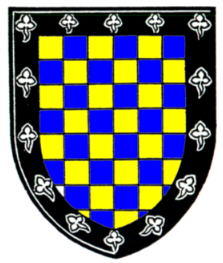
The Grantham (Crest) Coat of Arms
Tipperary and Grantham even share the same `colours`: Blue and Gold ! The Tipperary arms above show the arms of the Butler family, Earls of Ormonde.
Elements such as the golden cups and the blue and gold colours (also the county’s GAA colours) are taken from the Butler coat of arms.
The Grantham arms (left) was recorded at the Visitation of 1634, and is derived from the blue and gold chief or checks from the arms of the De Warrenne family, Earls of Surrey, who played an important role in the local history.
The De Warrenes came over with William the Conqueror as did the Milletts after the Normans defeated the English at the Battle of Hastings in 1066.
The Milletts arrived from Normandy, and settled in Buckinghamshire in England at first before arriving in Ireland and Tipperary during the wave of plantations and settlements spanning the 16th to 17th centuries.
William De Warenne, 5th Earl of Surrey was present at the coronation of King John of England on May 27th, 1199, the same King John who signed the Magna Carta on June 15th, 1215 and who built the castle in Tipperary where the town grew into an Anglo-Norman settlement.
The trefoils on the Grantham arms are likely to be a local symbol which is a very popular celtic symbol – the issue of infinity, while the green trefoil is considered by many to be the symbol of Ireland.
The trefoil is a symbol of perpetuity, with the three leaves representing the past, present and future.
It is also sometimes a symbol of fertility and abundance.
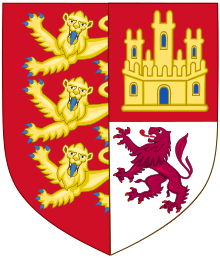
Arms of Eleanor of Castile, Queen of England
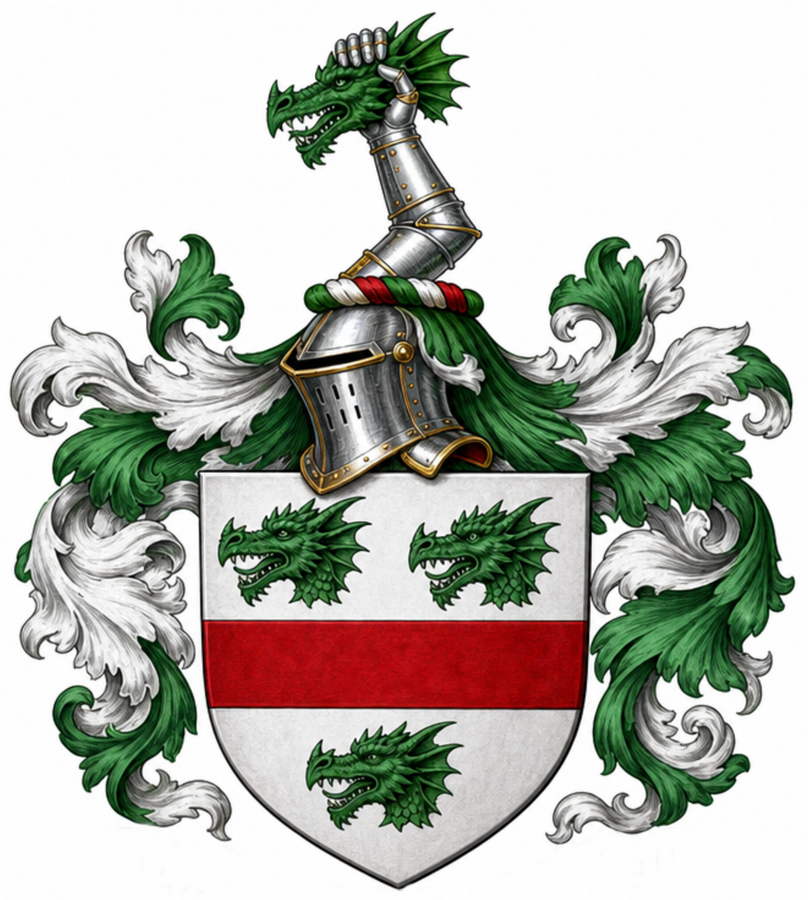
Arms of the Millett Family.
Symbolism: In heraldry, dragon heads often symbolise a display of military valour, courage, and the protection of treasure.
Motto: “Manus Haec inimica tyrannis”
The Latin motto translates to “This hand is an enemy to tyrants”.
For those that might be interested – on another historic connection to the actual town of Grantham itself and my ancestors is the noted Grantham Eleanor Cross and Eleanor of Castile herself.
Jane de Vere Hunt (1793–1871) of County Tipperary – my paternal 3rd great-grandmother shares a lineage traced directly to Eleanor of Castile through Lady Katherine Grey (1540–1568), Sir William Bonville (1392–1461) and Lady Margaret de Bohun, Countess of Devon (1311–1391).
Through the de Vere family tree, Jane is a descendant great-granddaughter of Eleanor’s many times removed.
Jane de Vere Hunt (born Jane Hunt) married Thomas Millett in County Tipperary, Ireland on September 18th, 1812, and died there on March 30th, 1871.
Her family of origin, the de Vere Hunts` primary family seat was the 774 acre Curraghchase Forest Estate in County Limerick for nearly 300 years (1657–1957). They descended from the noble English line of the de Veres, Earls of Oxford.
The family and their estate have a rich and well-documented history.
Eleanor of Castile was the wife of Edward I of England (Edward Longshanks), and Elizabeth was their daughter. Elizabeth`s brother, and Margaret’s uncle later became King Edward II of England and Lord of Ireland in 1307.
Queen Eleanor and King Edward were devoted to each other and the couple were rarely apart.
When Eleanor died in 1290 at Harby in Nottinghamshire which is only 22 miles from Grantham with Edward at her bedside, he spoke of her as the woman, “whom living we dearly cherished, and whom dead we cannot cease to love”.
Edward followed her body to burial in Westminster Abbey and erected large and elaborate stone memorial crosses at the site of each of the overnight stops between Lincoln and Westminster. Grantham marked the first overnight stop on the 200 mile funeral cortège from Lincoln to Westminster Abbey.
The original stone monument was once a centerpiece of Grantham’s busy medieval marketplace on St Peter’s Hill, is said to have stood near where the Isaac Newton statue stands today. No architectural fragments survive.
The “Eleanor Crosses” stood at Lincoln, Grantham, Stamford, Geddington, Northampton, Stony Stratford, Woburn, Dunstable, St. Albans, Waltham, Westcheap and Charing which later became known famously as Charing Cross. Charing Cross is said to be the centre of London from which all distances are measured.
Only 3 of the Eleanor Crosses survive and none in entirety.
The current Eleanor Cross at Charing Cross which can be seen in the foreground of the Charing Cross Station (London) forecourt is a replica.
The replica was finished in 1863 and has eight statues of Eleanor with kneeling angels at her feet. The original was attacked and destroyed by Oliver Cromwell’s forces and the Puritans and was sited where Whitehall meets Trafalgar Square.
Their purpose was to remind passers-by to say a prayer for the soul of the “Queen of Good Memory”, as Eleanor was called.
The Eleanor Cross at Grantham was built on what is now St. Peter’s Hill on the High Street which is five minutes walk from my new house over the River Witham and around the corner.
It is thought her coffin may have stood before the altar of the parish church of St. Wulfram’s.
As I said earlier, the Cross isn`t there anymore now as it was also destroyed by Oliver Cromwell’s forces later in the 17th century.
Just sharing a couple of poems below with you collaboratively composed for this article.
Two Landscapes, One Song
And Lincolnshire’s wide skies are worlds apart,
An ancient soil preserves the quiet green,
And whispers of the paths that lie between.
And sacred wells with living waters flow,
The Celtic soul inherits steel and glass,
And weaves its whispered magic through the grass.
To weave a modern, breathing tapestry.
From the Golden Vale to Fenland’s open plain,
The songs of home revive in summer rain.
Within the bustle of old Grantham town,
Is but to blend the fiddle with the breeze
That rustles through Lincolnshire’s ancient trees.
Where modern footsteps trace an ancient sign.
The Big Houses stood beneath a brooding sky.
The Ascendancy held the land and grand estate,
While underneath them, peasants bore the weight.
But turning wheels of history shift the ground,
And through the fields, a different cry would sound.
To break the ancient bonds of lord and fen.
For those who ruled, it brought a sudden fall,
As manor walls were stripped of power and all.
Yet for the Catholic poor, the fight was steep,
With generations of eviction leaving wounds too deep.
Where boycotts pierced the dark on every side.
A bitter strife of creed and class and claim,
Brought violence that left a brand of shame.
The Ascendancy watched their grand estates undone,
While Catholic kin bled out beneath the sun.
Left weeping mothers, one by one.
As want and sorrow gripped the shore,
They left the homes they loved before.
From Galway Bay and Cork they sailed,
Where hope had died and prospects failed.
By sorrow rooted deeply in the Irish ground.
Through shifting laws, through violence and through tears,
The island wept across the fractured years.
A shared, heavy grief upon the emerald shore,
Where none were left untouched by what they bore.